
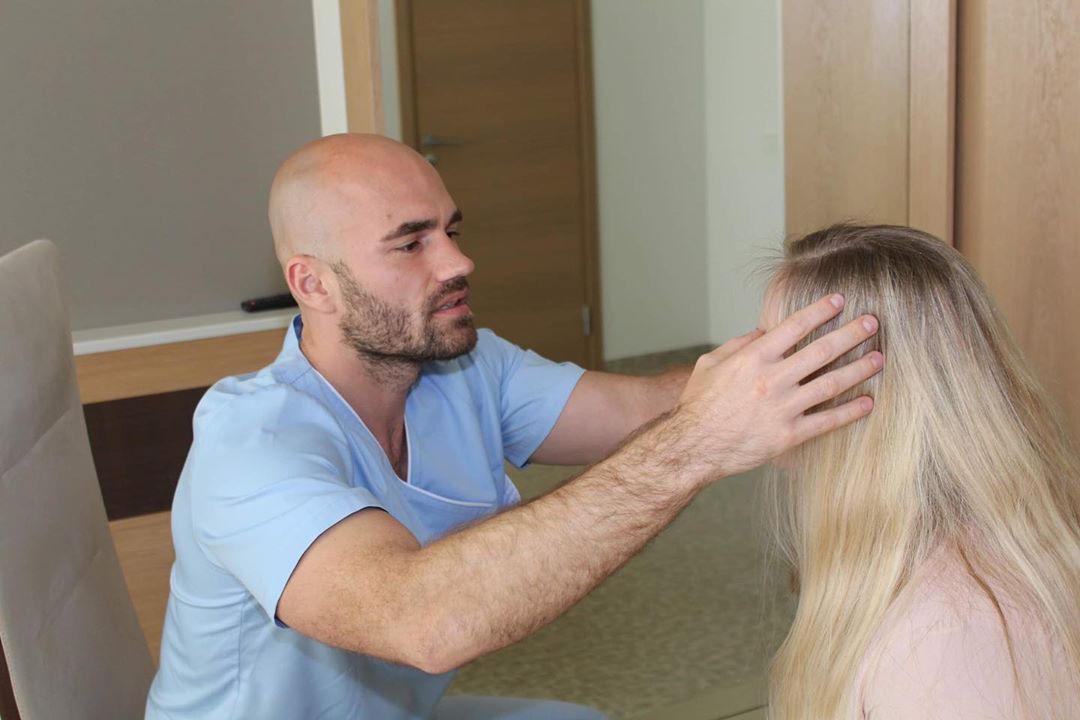
In direct communication with another person, the focus is primarily on their eyes and forehead. From this part of the face, one “reads” mood, emotions, and personal characteristics. Therefore, this facial area is the most important in an aesthetic and functional sense, where any change has a significant impact on the overall balance and harmony of the face.
Sometimes, rich inner beauty can be hidden behind frown lines, or drooping eyelids can create a tired and sad expression. Eyelid surgery and forehead correction are among the most popular aesthetic procedures, both among young and older individuals. Over a million upper and lower eyelid operations are performed worldwide each year. This is a surgical procedure during which a portion of the eyelid skin, the orbicularis oculi muscle, and periorbital fat tissue are partially removed to improve a tired appearance and restore functionality.
Upper eyelid surgery is often performed due to heavy eyelids that interfere with normal vision. Lower eyelid surgery, however, is generally common for improving aesthetic appearance.
The need for eyelid surgery due to impaired functionality arises for patients who have excess skin on their upper eyelids, or drooping eyelids. This is a common concern, primarily an age-related problem, and is also very prevalent among men.
Cosmetic correction is rather the removal of excess skin from the eyelids with the aim of improving appearance and restoring facial harmony. Performing an aesthetic operation does not depend on a person’s age, and often patients are only in their thirties.
More about the procedure
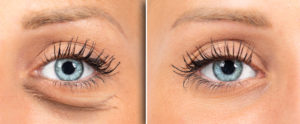 During a consultation with the surgeon, it will become clear whether a functionally and/or aesthetically satisfactory result can be achieved with the operation. Just as every patient is different, so are the solutions. If the operation is decided upon during the consultation and the patient arrives at the clinic on the morning of the operation day, the skin is first marked; nothing is left to chance. Local anesthesia is then administered, and the incision can begin. The entire procedure usually lasts one hour, but everything also depends on the patient and the complexity of the operation.
After the operation, the client spends a few hours in the clinic, and once the doctor has reviewed their condition and given further recommendations for wound care at home and pain management, the patient is allowed to go home. The patient needs to visit the clinic again 5-7 days later when it is time to remove the stitches. Generally, it is recommended to take 7-14 days of sick leave for this procedure, as the eyes can typically be swollen for that long, and bruise healing also takes time. Although the wounds heal and the skin looks good again within a couple of weeks, the long-term and best result will appear in about half a year, once the eye area has fully recovered.
After the operation, it is advisable to refrain from sports for a couple of weeks, as full-intensity exercise is only recommended after 4 weeks have passed. Saunas, swimming pools, solariums, and sunbathing should also be avoided.
Potential complications, in addition to all other procedures, can also occur with blepharoplasty, the most common of which are bruises, dry eyes, swelling, and uneven scar tissue, all of which will also be discussed and explained during the pre-operative consultation.
In summary, blepharoplasty is one of the best ways to improve one’s appearance, to restore a youthful and fresh look that would be impossible with creams alone. The scars from this surgery are sufficiently hidden, which is why the exact reason for the fresh and rested look is usually not understood.
In conclusion – it is always worth exploring different options to be the best version of yourself, and the best time for that is always now.
________________________________________________________________
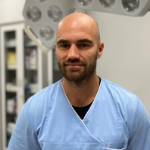 Dr Heiko Atna worked as an emergency medicine doctor in Finland after graduating from medical school in 2010, and witnessing various traumas led to the decision to enter reconstructive and plastic surgery residency. Dr Atna also works in this specialty at PERH.
Reconstructive surgery is a broad field where cosmetic procedures are just one part of it. Reconstructive surgery helps people live a full life even after accidents or traumas and corrects congenital defects.
At Kotka Private Hospital’s Plastic Surgery Center, in addition to eyelid surgery, Dr Atna performs breast augmentation and lifts, as well as laser procedures – for example, the removal of benign skin tumors.