
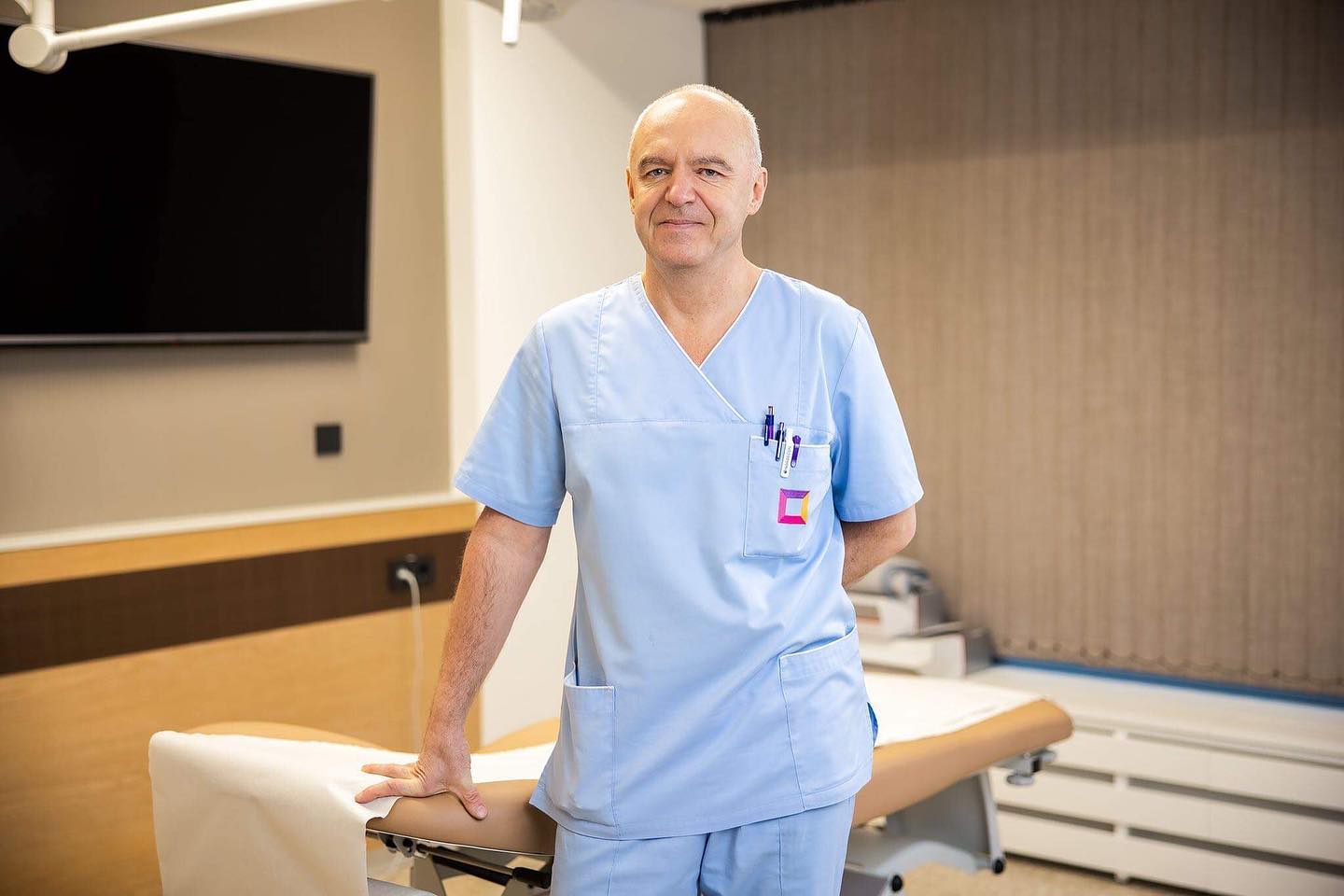
Kotka Private Hospital Plastic Surgery Center has received feedback as a private hospital with the best technology and cozy interior, whose reputation extends beyond borders.
There is also reason for trust, as patients are cared for by excellent trained, licensed experts in their field. One of them is a pioneer of Estonian plastic surgery with 30 years of experience, acclaimed plastic surgeon Dr. Jüri Kullamaa, most of whose approximately 600 annual operations are breast surgeries. “It can be said that 10,000 breast surgeries have definitely been performed,” confirms the highly regarded surgeon, whose patients’ ages range from 18 to 60 years.
Breast augmentation with silicone implants has been the most popular operation performed by Dr. Kullamaa for years. There are several reasons why women wish to enlarge their breasts – changes in breast shape due to pregnancy and breastfeeding, naturally very small breasts, medical reasons, etc.
Jüri admits that aesthetic surgery has made tremendous progress. It is no longer considered a disgrace, but an opportunity to improve one’s self-esteem and self-perception. Thus, young women who have just come of age also arrive in his office with a definite wish. “Since having children has been postponed to a later time, women no longer wait for childbirth to correct, for example, breast asymmetry. Today’s woman wants to enjoy a better appearance now, not wait 10 years.”
However, recovery from surgery takes longer for women who have not given birth. “Their recovery is more painful. This is because in women who have not given birth, the breast has not ‘moved’, for example, with weight gain. Hormonal factors also play a role here. For those who have given birth, healing is easier,” says Kullamaa.
At the first meeting with the surgeon, the details of the surgery are decided, including where to place the implant: whether under or over the muscle. There is no single rule here, as everything depends on the woman’s breast, body type, weight, etc., where it is more reasonable to place the implant. The implants themselves have also become much more elastic
and physically less noticeable.
Appetite grows with eating
According to Kullamaa, Estonian women typically have small breasts, so the average implant chosen weighs 300 grams, which increases the breast by about one and a half cup sizes. This means that a smaller B-cup can become a full C-cup with surgery. “Breasts can be enlarged step-by-step,” says the doctor, pointing out that an A-cup wearer cannot immediately become a D-cup wearer. “If we see that some women have very large breasts, it is the result of three or four operations.”
There are also smaller implants than 300 grams, which are placed in very slender women whose own breasts are very small. Dr. Kullamaa’s own “record” is 1200-gram implants, so he can confirm that appetite grows with eating. “Those 1200 grams were also custom-made implants
and an exceptional case in my practice. It should be noted that the same woman also had them removed quite quickly, because she developed back problems after the implants were inserted.”
Thus, the experienced doctor has also had to persuade patients in his work. “Often, beautiful women with beautiful breast shapes come in, who still want to change something. Considering all risks, I have asked them to reconsider. Every operation is a risk, and there should be a definite wish and need for it.” Why do women who seemingly don’t need surgery still end up at the aesthetic surgeon’s door? The doctor also knows the answer: “It should still be your own desire, not your partner’s.”
Fortunately, Kullamaa notes that although breast surgeries are an ongoing trend and need, women prefer a natural result rather than an over-inflated bust. “This is pleasing, and global practice also shows that the average implant is now 300 grams, whereas previously it tended to be 500 and 600
grams.”
Myths and Reality
According to Kullamaa, the biggest myth associated with breast surgeries is that implants last a lifetime. “In reality, it’s not like you have an operation, get an implant, and then keep it for life. Manufacturers do indeed give a lifetime warranty on implants, but that’s so they don’t break. However, we don’t know how they behave in our bodies. Therefore, the most important reason why they need to be replaced is that they encapsulate, meaning scar tissue forms around the implant.”
Although the time for implant replacement depends on several factors, the statistics are stark. “Within five years, 15 percent or even more of clients should replace their implants. However, there are patients who wear the same implant for 20 years, so a definitive answer cannot be given that you should replace it every two years and you every five years,” says the doctor. “For example, yesterday a patient came in who had happily worn implants I placed 19 years ago. She had given birth seven years ago, after which her breast shape had changed, and now needed adjustment.” Thus, according to Kullamaa, everything depends on the individual, adding that the work is, after all, made from the client’s material.
Another important topic to discuss in connection with breast augmentation surgeries is silicone incompatibility or rejection reaction, which cannot be predicted in advance. Dr. Kullamaa emphasizes that every operation carries a risk, and the possibility that something may not go as hoped is always present. “Rejection reaction
involves inflammation or infection. With any operation, there’s a possibility that something might fester. And if you place a foreign body, i.e., a breast implant, there, then this percentage is 1–2. It’s clear that we try to reduce this, but unfortunately, you can never know.”
Based on Kullamaa’s experience, complications have rather occurred in those who had both a breast lift and an implant placed at the same time. “Then the entire skin surface is open, bacteria move, and inflammation can occur more easily in the incision area.”
“When can I go to the gym?”
Before the operation, one should first go for a consultation. During the meeting, the doctor can find the most suitable solution based on their experience. After that, the patient will undergo examinations and mammography, all of which can be conveniently done right here in the Kotka Private Hospital building. “If everything is in order, we can immediately set the operation date. There are places where the operation is performed in the morning and the patient is sent home in the evening, but I prefer to keep patients under observation overnight. This way, both parties feel more secure.”
The recovery process, on the other hand, is longer and extremely important. “We live in an age where everyone exercises five days a week, so the main question I hear after surgery is when they can work out again,” the man laughs. However, one can only return to exercise after a month, but the doctor recalls
cases where a woman who had just gotten off the operating table a week ago had already made it to the gym. “I can’t control what everyone does in their free time,” says Kullamaa, and asks everyone to take care of themselves for a good outcome.